
What if your calendar, pauses, check-ins, and smallest decisions were quietly teaching your team how to experience your leadership? Read the full review to discover the answer for yourself there.
Book
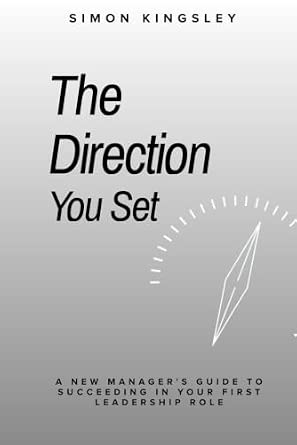
The Direction You Set by Simon Kingsley
Genre: Business & Economics / Nonfiction
Sub-genres: Leadership; Management; Professional Development; Career Development; Workplace Skills; Management Training
Themes: Leadership transition; first-time management; trust; delegation; accountability; communication; feedback; difficult conversations; team development; coaching; conflict resolution; organisational change; prioritisation; workplace wellbeing; professional growth; leadership judgement; career progression.
Minimum age: Adult/professional readership, approximately 18+, although the content itself does not contain adult material.
Review
A promotion can change a person’s calendar before it changes their instincts. On Monday, someone may still be the person who solved the difficult problem, wrote the report or delivered the work. By Tuesday, colleagues may be asking that same person to decide what others should do. What happens in between is the territory explored by The Direction You Set.
Simon Kingsley’s management guide begins with a useful observation: the abilities that make someone successful as an individual contributor are not necessarily the abilities required when that person becomes responsible for other people. The manuscript calls this transition “The Gap,” and uses it as a starting point for examining the practical and psychological adjustments involved in becoming a manager.
The book’s greatest strength is its practicality. It does not attempt to turn management into a collection of abstract theories. Instead, it repeatedly asks what a manager should actually do when confronted with familiar workplace situations: a team member struggling with an assignment, a meeting without a clear purpose, an uncomfortable conversation that has been postponed, competing priorities, conflict between employees, organisational change or a request from above that threatens to overload the team.
Delegation receives particularly useful treatment. Kingsley distinguishes delegation from abdication, arguing that handing someone a task does not mean handing away responsibility for the outcome. The book’s “brief, monitor, debrief” framework gives that idea a memorable structure: provide context and authority, maintain appropriate awareness, and then close the loop by examining what happened.
Trust is treated similarly as something accumulated through repeated behaviour rather than granted automatically with a job title. The book’s trust model identifies competence, reliability, and character or intent as contributing elements. The accompanying diagram makes the point visually, while the surrounding discussion stresses that small commitments and consistent behaviour can matter more than impressive gestures.
Another worthwhile feature is the attention given to the manager’s own sustainability. Later chapters address support networks, boundaries and burnout, recognising that a manager who attempts to absorb every problem can eventually become a bottleneck rather than a source of stability. The discussion connects this directly to earlier arguments about delegation and developing people’s judgement.
The book is also strongest when it acknowledges judgement rather than pretending every management situation has a formula. The chapter on stepping in and stepping back explicitly presents this as an ongoing assessment of context, competence and stakes. That is more realistic than prescribing permanent micromanagement or permanent hands-off leadership.
The Direction You Set is best suited to first-time managers, aspiring supervisors, team leaders and professionals who have entered management without formal preparation. It is less suited to readers seeking an academic management text or an extensive research review. Its value lies elsewhere: it offers a practical set of questions, habits and frameworks for someone learning that leadership is less about personally completing the work and more about creating the conditions in which other people can do it well.
The book’s central question is therefore a useful one: if small decisions gradually establish a manager’s pattern, what direction are those decisions setting?
Content Warning: Brief references to workplace misconduct, wrongful termination, safety failures, fatal aviation crashes, burnout and occupational stress.
Other Stories

Book Review: A Moment’s Surrender by John Burt
What if the hardest person to forgive is the version of yourself you meet in someone else’s grief? A Moment’s Surrender by John Burt explores it; read the full write-up.
Keep reading
Book Review: Birds Beyond Reach by Dwayne Ulliac
Can chasing a bird teach someone more about love than chasing a dream? In Dwayne Ulliac’s Birds Beyond Reach, read the full write-up to discover why this strange question matters.
Keep reading
Book Review of In My Mother’s Footsteps: Poems of Love & Loss by Rachel Peck and Barbara Dickenson
Can a jam tart, a snowflake, or an old chair remember someone better than we can? In In My Mother’s Footsteps by Rachel Peck, read the review to find out.
Keep reading
Book Review: Welcome to Mapleberg by Tye Burroughs
What if a town became so orderly that finding the truth became the real crime? Welcome to Mapleberg by Tye Burroughs explores that question; read the full review to discover.
Keep reading
Book Review: Tesler & the Burning Bush by Mark W. Sasse
What happens when the richest man alive decides that civilization is the problem? Tesler & the Burning Bush asks an unsettling question readers can explore by reading the full review.
Keep readingWe’d love to hear from you!
What are your thoughts on this piece? Share your insights in the comments below!
- What stood out to you most about this post?
- Have you read a book recently that relates to the themes discussed here?
- What’s your favorite takeaway or reflection from this write-up?
Let’s keep the conversation going—your thoughts make this space richer!
Disclaimer: The content on this site is provided for informational and inspirational purposes only. While we strive for accuracy, the views expressed in reviews, articles, and recommendations are subjective and may not reflect the opinions of all readers.
We receive complimentary copies of all books we review. However, this practice does not compromise the integrity or honesty of our reviews. Every write-up reflects the contributor’s genuine impressions and critical analysis, ensuring transparency and trust with our readers.
For a complete understanding of our practices, please refer to our full Disclaimer, Privacy Policy, and Terms of Service. These documents outline how we manage your information, ensure transparency, and uphold your rights as a user.
To request for a review, to nominate your favorite book for an award, or for more details about our awards, click here.
Other Stories

Past Tense by LindaAnn LoSchiavo
Can twenty-three different poetic forms make silence speak without pretending to know everything? Past Tense by LindaAnn LoSchiavo invites readers to investigate through poetry together.

Rajat Chohda: Exploring Conscious Living Through Reflection and Everyday Practice
Can a question about an ordinary family conversation change how you define success? Rajat Chohda explores this journey through his experiences, ideas, and writing; read the full interview to discover.

Turning by Wayne Feinstein
What if the loudest room you’ve ever entered was your own memory? Discover how Turning by Wayne Feinstein explores that unexpected question in our full review.


