
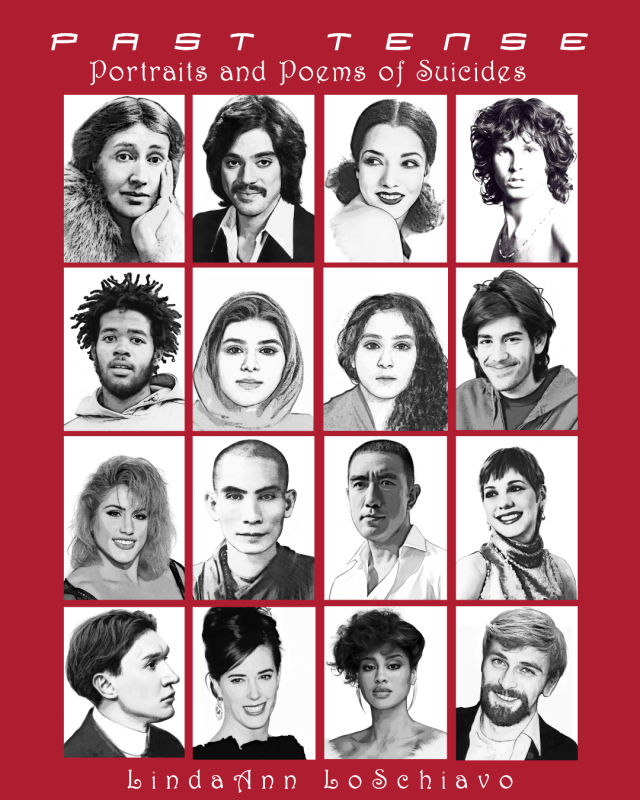
Can twenty-three different poetic forms make silence speak without pretending to know everything? Past Tense: Portraits and Poems of Suicides by LindaAnn LoSchiavo invites readers to investigate through poetry together.
Past Tense: Portraits and Poems of Suicides by LindaAnn LoSchiavo
Genre: Poetry / Literary Nonfiction
Sub-genres: Biographical Poetry, Historical Poetry, Formalist Poetry, Documentary Poetry, Elegy
Themes: Memory, grief, identity, mental health, stigma, family, cultural history, fame, responsibility, remembrance, human dignity
Content Warning: Mature themes involving suicide, death, grief, mental-health struggles, addiction, abuse, and other traumatic life circumstances.
What do you do with a historical record that tells you when a person died but not how that person felt while living? Past Tense approaches that gap through research, portraiture, quotation, and poetic form. Rather than presenting a continuous biography, LindaAnn LoSchiavo assembles twenty-three individual studies, each functioning almost like a small literary exhibit.
The book’s design contributes to that effect. A portrait appears, a quotation establishes an immediate voice, and then a poem changes the distance between reader and subject. The subjects range widely in profession and public visibility, from writers and performers to scientists, athletes, activists, artists, and people whose names are far less familiar. The table of contents makes the organizing principle clear: the collection deliberately varies its poetic machinery from one portrait to the next.
That formal variety is the book’s strongest craft decision. A poem can be an erasure, cento, Golden Shovel, acrostic, computer-code poem, Fibonacci poem, or villanelle. The author explains that these choices were made in relation to the evidence and personality surrounding each subject rather than imposed as a single template. For readers who enjoy seeing poetry techniques used as structural tools rather than classroom exercises, this is fertile territory.
There is also an important distinction between documentation and imagination. LoSchiavo says she worked from newspaper archives, obituaries, trial records, interviews, recordings, online material, and published writings. She describes the challenge as resisting the urge to smooth all twenty-three lives into one shape. That method gives the collection a documentary backbone while leaving room for poetic interpretation.
The collection is especially effective when a formal constraint creates meaning. The code poem for Aaron Swartz, for instance, turns language associated with his professional life into the poem’s visual and conceptual structure. The experiments therefore become more than clever tricks: they ask a practical literary question. If every person leaves behind a different kind of evidence, should every memorial poem sound the same?
The answer offered here is clearly no.
Another strength is the refusal to make every subject morally identical. The author states that some people are mourned without reservation while others are not excused, and that the emotional range is intentional. That gives the collection greater credibility than a uniformly reverential memorial book would have had.
Readers should understand the book’s limits. Poetry is not forensic reconstruction, and a poem can suggest an interior reality that cannot be proved from historical records. Some readers may therefore want to pause after each portrait and separate what is documented from what is artistically imagined. That tension is worth noticing rather than ignoring.
Past Tense is best suited to mature readers who appreciate literary experimentation and are willing to spend time with difficult subjects. It is not a casual bedside collection or a conventional life-story anthology. Its appeal lies in its hybrid nature: part memorial, part research project, part formal poetry laboratory, and part meditation on what remains after a person becomes history.
Its deepest achievement is not that it explains every life. It is that it insists every life was larger than its final chapter.
Help is available
If you are experiencing overwhelming thoughts or emotions, or are worried about someone else, please know that support is available. The following information may be helpful to you:
1. When in Australia, here’s the information from health.gov.au:
In case of emergency, dial 000.
For immediate assistance, support is accessible 24/7 across Australia. Reach out to:
- Lifeline: 13 11 14
- Kids Helpline: 1800 55 1800
- Mental Health Crisis Assessment and Treatment Team in your state/territory
- Beyond Blue: 1300 224 636
For urgent care, visit the emergency department at your local hospital.
2. Here are other links for important contact details in countries across the globe compiled by Wikipedia:
Emergency telephone numbers per country
List of crisis lines per country
Voyages of Verses Book Award

This book is a winner of the Voyages of Verses Book Award, a recognition for books that expand the horizon of what literature can achieve. We honor works that challenge preconceived notions, broaden worldviews, and celebrate the rich blend of voices that shape our global narrative. Whether it’s a novel that immerses you in a different culture, a collection of poems that captures the essence of shared humanity, or a nonfiction account that sparks critical thought, the Voyages of Verses Book Award celebrates stories that invite exploration and discovery.
We’d love to hear from you!
What are your thoughts on this piece? Share your insights in the comments below!
- What stood out to you most about this post?
- Have you read a book recently that relates to the themes discussed here?
- What’s your favorite takeaway or reflection from this write-up?
Let’s keep the conversation going—your thoughts make this space richer!
Disclaimer: The content on this site is provided for informational and inspirational purposes only. While we strive for accuracy, the views expressed in reviews, articles, and recommendations are subjective and may not reflect the opinions of all readers.
We receive complimentary copies of all books we review. However, this practice does not compromise the integrity or honesty of our reviews. Every write-up reflects the contributor’s genuine impressions and critical analysis, ensuring transparency and trust with our readers.
For a complete understanding of our practices, please refer to our full Disclaimer, Privacy Policy, and Terms of Service. These documents outline how we manage your information, ensure transparency, and uphold your rights as a user.
To request for a review, to nominate your favorite book for an award, or for more details about our awards, click here.
Other Stories
Rajat Chohda: Exploring Conscious Living Through Reflection and Everyday Practice
Can a question about an ordinary family conversation change how you define success? Rajat Chohda explores this journey through his experiences, ideas, and writing; read the full interview to discover.
Turning by Wayne Feinstein
What if the loudest room you’ve ever entered was your own memory? Discover how Turning by Wayne Feinstein explores that unexpected question in our full review.
Meditation for Cancer: A Practical Companion for Patients, Families and Caregivers by Arumi Nomad
What if the strongest medicine you carried couldn’t fit inside a bottle? Discover how Meditation for Cancer by Arumi Nomad explores that surprising question in our complete review.


