
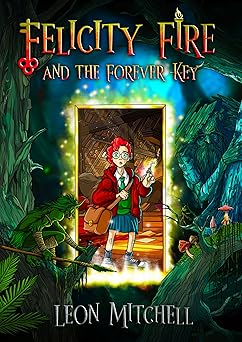
What if the thing that keeps making you late is actually trying to lead you somewhere? Felicity Fire and the Forever Key by Leon Mitchell lets readers discover why—if they dare to follow.
Felicity Fire and the Forever Key by Leon Mitchell
Genre:
Children’s Fantasy
Sub-Genres:
Portal Fantasy, Quest Adventure, Magical Realism
Themes:
Belief, resilience, bullying, identity, courage, imagination, friendship, self-trust
Recommended Age Range: Ages 9–12 (Upper Middle Grade)
The story suits confident readers due to its intense school dynamics, exaggerated authority figures, and fast-moving fantasy elements. Younger readers may require guidance.
Review
There is a particular kind of childhood exhaustion that comes not from being tired, but from constantly feeling one step behind the world. Felicity Fire and the Forever Key understands that feeling intimately. Before the magic arrives, before the riddles and keys and strange doors, the book grounds itself in a reality many readers know well: the fear of being late, of being singled out, of being misunderstood by systems that are louder than they are kind.
Leon Mitchell writes with a bold, almost theatrical energy. Authority figures are outsized, bullies are operatic, and school corridors feel like obstacle courses rather than hallways. This is not subtle realism; it is emotional realism turned up to eleven. Developmental psychologists have long noted that children often perceive adult authority as overwhelming and absolute, and the book mirrors that perception through caricature rather than restraint. The result is a world that feels truthful even when it is absurd.
When the story opens into fantasy, it does so naturally. The magical elements don’t replace Felicity’s struggles; they reflect them. Doors become choices, keys become responsibility, and belief is treated not as wishful thinking but as an active skill. The quest structure is classic, but it never feels derivative because it is anchored so firmly in Felicity’s inner life. The danger matters because she does.
What works especially well is the book’s refusal to present courage as instant or effortless. Felicity does not transform into a fearless hero overnight. She hesitates, missteps, and doubts herself repeatedly. Neuroscience research on learning and confidence shows that persistence through uncertainty builds long-term resilience more effectively than immediate success, and the story embodies that principle without preaching it.
The humour will be divisive. It leans heavily into slapstick, grotesque imagery, and exaggerated embarrassment. For many young readers, this will be a feature rather than a flaw. It keeps the pacing lively and the tone accessible, even when the stakes rise. Adults reading alongside children may occasionally wince, but the intent is never cruel for its own sake.
This book is for readers who enjoy fast movement, strange worlds, and protagonists who feel real rather than polished. It is for children who have ever felt overlooked, underestimated, or quietly capable of more than anyone expects. It may not suit readers looking for gentle minimalism or lyrical restraint, but it will resonate with those who value imagination as a survival skill.
By the final pages, Felicity Fire and the Forever Key makes a clear case for belief—not as fantasy, but as a choice. And that is a message worth unlocking.
Content Warning
Includes stylised depictions of bullying, exaggerated authority figures, slapstick bodily humour, and cartoonish menace. No explicit content.
Other Stories
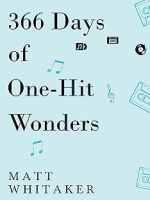
366 Days of One-Hit Wonders by Matt Whitaker
What if the song you still hum once a year quietly reshaped music history? 366 Days of One-Hit Wonders by Matt Whitaker reveals how fleeting hits leave permanent echoes.
Keep reading
The Lies That Bind by K. J. Ritchie
What if the stories meant to protect us quietly taught us how to endure harm instead? This piece explores that unsettling question—read on to uncover how and why it matters.
Keep reading
The Art of Connection – Stories That Explore the Bonds That Shape Us
In a world filled with technology and rapid communication, true connection remains one of the most profound and elusive experiences. Literature offers us glimpses into the relationships that shape our lives—those that challenge, support, and transform us.
Keep reading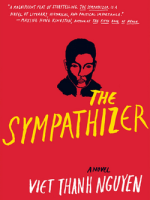
Review of The Sympathizer by Viet Thanh Nguyen
Viet Thanh Nguyen’s Pulitzer Prize-winning novel, The Sympathizer, is a masterful exploration of identity, loyalty, and the aftermath of war.
Keep reading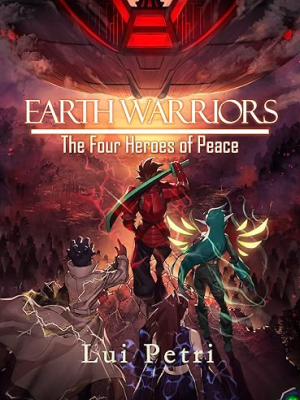
Earth Warriors: The Four Heroes of Peace by Lui Petri
What happens when peace itself is labeled weakness in a universe obsessed with evolution through force? This piece explores that question—and why four unlikely survivors may hold the answer.
Keep readingWe’d love to hear from you!
What are your thoughts on this piece? Share your insights in the comments below!
- What stood out to you most about this post?
- Have you read a book recently that relates to the themes discussed here?
- What’s your favorite takeaway or reflection from this write-up?
Let’s keep the conversation going—your thoughts make this space richer!
Disclaimer: The content on this site is provided for informational and inspirational purposes only. While we strive for accuracy, the views expressed in reviews, articles, and recommendations are subjective and may not reflect the opinions of all readers.
We receive complimentary copies of all books we review. However, this practice does not compromise the integrity or honesty of our reviews. Every write-up reflects the contributor’s genuine impressions and critical analysis, ensuring transparency and trust with our readers.
For a complete understanding of our practices, please refer to our full Disclaimer, Privacy Policy, and Terms of Service. These documents outline how we manage your information, ensure transparency, and uphold your rights as a user.
To request for a review, to nominate your favorite book for an award, or for more details about our awards, click here.
Other Stories
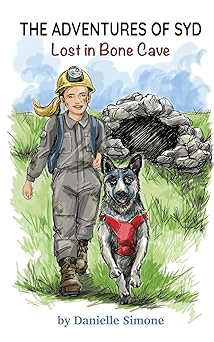
Lost in Bone Cave by Danielle Simone
What would you notice first if the dark suddenly became your only map? Lost in Bone Cave by Danielle Simone explores that question—discover how by reading the full write-up.

Stray: Breaking Free, Falling Hard, and Growing Stronger by Shannon O’Brien
Have you ever wondered why some people discover their strongest selves only after getting completely lost—literally and emotionally? This piece explores that question, and you’ll find the surprising insight within the full write-up.

Following the Story: Harker Jones on Writing Across Genres and Ages
What happens when stories choose their own form? In this interview, readers explore how a writer follows ideas across ages and genres, discovering the answer by reading the full conversation.

 OneTribune