
What if the stories meant to protect us quietly taught us how to endure harm instead? This piece explores that unsettling question—read on to uncover how and why it matters.
Book Title & Author
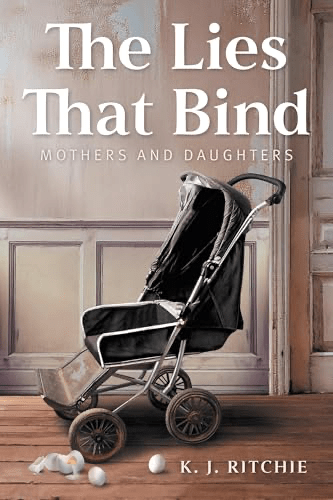
The Lies That Bind by K. J. Ritchie
Genre, Sub-Genres, and Themes
- Genre: Literary Fiction
- Sub-Genres: Family Saga, Psychological Drama, Historical Fiction
- Themes: Intergenerational trauma, motherhood, silence, control, survival, memory, truth, moral reckoning
Review
Some novels announce their purpose loudly; others sit across from you, speaking softly until you realize you cannot look away. The Lies That Bind belongs to the second category. It is a novel that understands how damage is rarely sudden and almost never isolated. Like trauma itself, it accumulates quietly, disguised as routine, obligation, or love.
Ritchie anchors her story in domestic spaces—kitchens, bedrooms, gardens—that are culturally coded as safe. Neuroscience tells us memory is often strongest where emotion is most intense, and this novel makes full use of that truth. The house becomes a living archive, storing harm the way walls hold sound. What happens behind closed doors does not stay there; it shapes decisions decades later, often without conscious intent.
The book’s greatest strength lies in its refusal to simplify its characters. Caregivers fail not because they are villains, but because they are human, constrained by fear, denial, and social expectation. Victims are not portrayed as fragile archetypes but as adaptive thinkers, making choices within impossible limits. This psychological realism aligns with well-documented trauma responses: compartmentalization, delayed disclosure, and conflicted attachment.
Ritchie’s prose is direct and unornamented, which paradoxically makes the emotional impact stronger. There is no aesthetic cushioning. The writing mirrors how survivors often recount experience—clear, factual, and devastating in its restraint. The structure, moving across timelines and viewpoints, reflects how the past refuses linearity. Trauma studies confirm that memory often resurfaces out of sequence, and the novel honors that reality.
This is not a story interested in easy redemption. Accountability matters here, but so does context. The book asks uncomfortable questions: What happens when protection becomes possession? When silence masquerades as peace? When survival strategies calcify into cruelty? These are not rhetorical flourishes; they are the engine of the narrative.
The Lies That Bind is for readers who value emotional honesty, psychological depth, and literature that challenges without sensationalizing. It is not for those seeking escapism, neat resolutions, or moral binaries. Think of it as a long conversation you didn’t plan to have but are ultimately grateful you endured.
Content Warning
This book contains depictions of emotional abuse, sexual assault, self-harm, and suicidal ideation. Readers sensitive to these themes may wish to proceed with care.
Other Stories

Carmella Parker on Law, Education, and Guiding Institutions Through Change
How do you teach students about laws that are still being written? This interview explores one legal educator’s answer—revealed through experience, strategy, and real-world change inside the evolving legal landscape.
Keep reading
The Stress Book by Dr. D. Terrence Foster
What do dental floss, your Wi-Fi signal, and your unresolved childhood goals have in common? Surprisingly, a lot. Read on to see how they all tie into your everyday stress—and how this book untangles it.
Keep reading
Grieving Ic by Edward Michael Supranowicz
What does a feeling look like when it turns symmetrical? Spend time with Edward Michael Supranowicz’s artwork, let its forms speak, and discover meaning by lingering with the image quietly.
Keep readingBook Review: The Stress Book by Dr. D. Terrence Foster
If an octopus could text, juggle, cook, plan a future, soothe trauma, and still feel behind—would it read The Stress Book? You’ll find out why that’s relevant as you read on.
Keep reading
Once A King, Now A Prince by Ira Blacker
What happens when imagination becomes a survival skill instead of a pastime? Once A King, Now A Prince by Ira Blacker reveals the answer—if you’re willing to follow the journey.
Keep readingWe’d love to hear from you!
What are your thoughts on this piece? Share your insights in the comments below!
- What stood out to you most about this post?
- Have you read a book recently that relates to the themes discussed here?
- What’s your favorite takeaway or reflection from this write-up?
Let’s keep the conversation going—your thoughts make this space richer!
Disclaimer: The content on this site is provided for informational and inspirational purposes only. While we strive for accuracy, the views expressed in reviews, articles, and recommendations are subjective and may not reflect the opinions of all readers.
We receive complimentary copies of all books we review. However, this practice does not compromise the integrity or honesty of our reviews. Every write-up reflects the contributor’s genuine impressions and critical analysis, ensuring transparency and trust with our readers.
For a complete understanding of our practices, please refer to our full Disclaimer, Privacy Policy, and Terms of Service. These documents outline how we manage your information, ensure transparency, and uphold your rights as a user.
To request for a review, to nominate your favorite book for an award, or for more details about our awards, click here.
Other Stories

Review of Holy Parrot by Angel A
When was the last time you let a question remain unanswered—on purpose? In Holy Parrot, you’ll discover why uncertainty can sometimes be the most generous truth.

Beyond the Obstacle – Stories of Resilience, Courage, and Overcoming
Here are some powerful books that take readers beyond the obstacle and into the light of victory.
Substance: A Woman’s Guide to Living Her Full Potential in God by Leeanna Allen
What if the thing quietly shaping your life isn’t your personality, past, or plans? Substance by Leeanna Allen invites you to discover the answer—inside the full review.

 OneTribune