
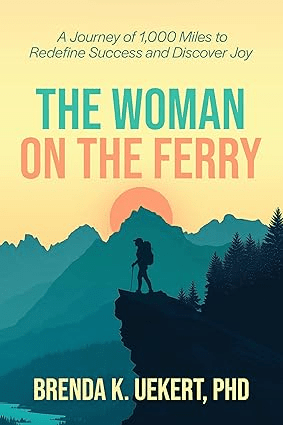
Gentle. Gritty. Grounding.
In 1964, Dorothy Molter was told to vacate her wilderness home. Instead, she stayed, served root beer, and lived out her life in solitude on Isle of Pines. Like Molter, many women have chosen the wild over convention—not to escape life, but to embrace it. Brenda Uekert’s reflective memoir enters this lineage of seekers, women who aren’t fleeing, but listening. In a world where productivity often trumps peace, Uekert’s journey offers a trail map back to meaning.
This is not a tale of epic summits or death-defying feats. Instead, it’s a bold and tender recalibration of what success means when everything externally collapses. After professional setbacks and a symbolic sprained ankle on her 60th birthday, the author sets off to hike 1,000 miles over five months. Not to conquer mountains, but to understand why her soul feels like it’s lived too long in tight shoes. Her trail becomes a confessional, a prayer, and a protest against conventional timelines and definitions. Readers follow her as she logs miles around an RV park, battles a UTI mid-hike, survives jammed doors and fried surge protectors, and dreams up postcard messages from a woman named Celeste—a ferry passenger she barely spoke to years ago, who now lives on in spirit as her imagined wilderness muse.
Uekert’s language carries a subtle musicality that mirrors the rhythmic crunch of gravel beneath her boots. From confessions about being a “weather wimp” (a humorous self-label that many will find deeply relatable) to the revelation that “Minion Miles” on mundane campground loops might hold just as much meaning as forest treks, her storytelling rings with honesty and clarity. There’s polish here, but no pretense. Readers will recognize themselves in her spreadsheets, in her doubt, and in the pie slice she rewards herself with for hitting 200 miles. Her background as a PhD is not a platform for authority—it’s the undercurrent that proves she’s been steeped in systems long enough to know how to walk away.
The craft of this book lies in how it weaves metaphor and memory into action. The book could easily be read in short bursts, like trail markers—each chapter is a blend of narrative, reflection, and visualized epistles from Celeste that feel more grounding than lofty. My favorite part appears early on, when she describes watching an older woman absorb a Caribbean ferry crossing like sacred liturgy—a moment so quiet and vivid, you’ll want to sit with it before turning the page.
This is not a book for cynics. Those seeking adrenaline-packed adventure or academic rigor may find the book too introspective or gentle. But for readers who long for authenticity and unvarnished transformation—especially women at midlife crossroads—it will be revelatory. It echoes the spirit of Cheryl Strayed’s Wild, yet it feels more neighborly than heroic, more Mary Oliver than Elizabeth Gilbert.
What makes this book truly remarkable is its refusal to sell a happy ending. Instead, it invites you to keep walking. Uekert doesn’t claim to have “found herself.” She claims the act of becoming. And in that claim lies the gift she offers to all of us.
In the end, The Woman on the Ferry is not just a memoir—it’s a lantern. It reminds us that sometimes, the greatest destinations are not places, but ways of being. That even if your life cracks like a ceramic teacup, it can still catch the light.
Booknomad Tales Five Stars Award

This book is a winner of the Booknomad Tales Five Stars Award, an accolade that reflects the mission of Booknomad Tales: to explore literature that resonates universally, while celebrating the distinct voices that make global storytelling so vibrant. Whether it’s a contemporary novel, a poignant memoir, or an evocative collection of poetry, award-winning books embody the heart and soul of what it means to be a nomad of the literary world.
We’d love to hear from you!
What are your thoughts on this piece? Share your insights in the comments below!
- What stood out to you most about this post?
- Have you read a book recently that relates to the themes discussed here?
- What’s your favorite takeaway or reflection from this write-up?
Let’s keep the conversation going—your thoughts make this space richer!
Disclaimer: The content on this site is provided for informational and inspirational purposes only. While we strive for accuracy, the views expressed in reviews, articles, and recommendations are subjective and may not reflect the opinions of all readers.
We receive complimentary copies of all books we review. However, this practice does not compromise the integrity or honesty of our reviews. Every write-up reflects the contributor’s genuine impressions and critical analysis, ensuring transparency and trust with our readers.
For a complete understanding of our practices, please refer to our full Disclaimer, Privacy Policy, and Terms of Service. These documents outline how we manage your information, ensure transparency, and uphold your rights as a user.
To request for a review, to nominate your favorite book for an award, or for more details about our awards, click here.
Other Stories

Reimagining Life Through Words and Service with Debra J. White
What happens when life’s hardest blows lead to unexpected purpose? Discover how Debra turned trauma, recovery, and rescued animals into writing and volunteer work that inspires resilience and connection.
The Half That Runs by Luz Schweig
What if your memories had a geography—one that kept shifting under your feet like sand? Discover how The Half That Runs by Luz Schweig maps identity—read the full piece.
Book Review: Climb Greater Heights by Tony Jeton Selimi
What if your biggest business obstacle isn’t competition but something invisible within you? Discover the answer in Climb Greater Heights by Tony Jeton Selimi—read the full review to explore.

 OneTribune
