
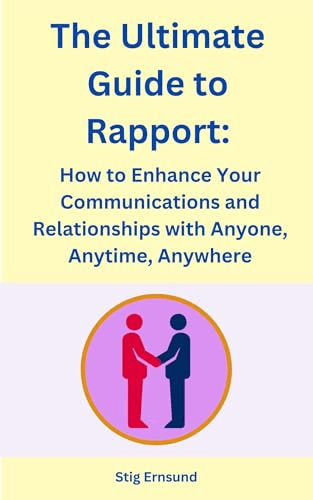
Content Warning: This book is suitable for all audiences, including professionals, students, and parents. However, readers should be mindful that techniques for building rapport could be misused in manipulative ways. Ernsund emphasizes ethical application, but the responsibility ultimately lies with the reader.
Rapport: An Ancient Survival Mechanism Disguised as a Social Skill
Ernsund doesn’t just define rapport; he traces it back to our evolutionary wiring. He introduces The Evolutionary Bonding Theory, drawing from anthropologist Robin Dunbar’s research on why early humans had to form alliances for survival. Ever wonder why you instantly “click” with some people while others feel like trying to start a car with a dead battery? It’s not magic—it’s biology.
Even Attachment Theory makes a cameo, reminding us that our childhood relationships with caregivers shape how we connect as adults. It’s a humbling revelation: our ability to forge deep connections isn’t just about polished conversation skills—it’s about centuries of genetic programming and our earliest experiences of trust and vulnerability.
Mirror Neurons and the Science of “Vibing”
Science fiction often imagines a world where humans can instantly download each other’s thoughts. But Ernsund argues that we already possess a form of this telepathic superpower—mirror neurons. When someone smiles at us, we often smile back. When someone is tense, we feel it in our bones. He explains that these neurons are at the core of rapport, making it less of an abstract “soft skill” and more of a measurable neurological event.
Imagine two people locked in conversation, their speech rhythms aligning like synchronized swimmers. That’s mirror neurons in action, subtly paving the way for fluid communication. Ernsund’s insight? You can train this instinct to build trust in business, deepen relationships, and even diffuse conflicts before they escalate.
Rapport is Not Just for Salespeople—It’s a Social Cheat Code
Most books on rapport are written for sales professionals or dating gurus, but Ernsund takes a refreshingly broader approach. He argues that rapport is a universal human tool—one that parents use with children, therapists use with clients, and even politicians wield to sway audiences. The book’s chapters on Matching, Commonalities, and Active Listening aren’t just about conversation techniques; they’re about understanding the psychological dynamics that make someone feel truly seen.
Think about the last time you met someone who made you feel like the most interesting person in the room. Did they subtly mirror your posture? Repeat your words back to you in a slightly different way? Ernsund would say they weren’t just being nice—they were using rapport techniques, whether they knew it or not.
Ethics: The Unspoken Dilemma of Rapport
A critical question lingers throughout the book: Can rapport be manipulated? Ernsund tackles this head-on, emphasizing that rapport must be mutual and ethical. He warns against using these techniques to deceive or manipulate, a concern that echoes through everything from high-stakes business deals to political campaigns. His stance? Rapport is a tool, and like any tool, its impact depends on the intent of the user.
Final Verdict: A Masterclass in Connection
At its heart, The Ultimate Guide to Rapport is about much more than social skills—it’s about re-learning a fundamental truth: human connection is both an art and a science. Ernsund’s approach is rigorous, practical, and unexpectedly philosophical.
For those who have always viewed rapport as an intangible “you either have it or you don’t” skill, this book serves as both a wake-up call and a toolkit. Whether you want to become more persuasive, build deeper relationships, or simply understand why some conversations flow while others fall flat, this book is a must-read.
Voyages of Verses Book Award

This book is a winner of the Voyages of Verses Book Award, a recognition for books that expand the horizon of what literature can achieve. We honor works that challenge preconceived notions, broaden worldviews, and celebrate the rich blend of voices that shape our global narrative. Whether it’s a novel that immerses you in a different culture, a collection of poems that captures the essence of shared humanity, or a nonfiction account that sparks critical thought, the Voyages of Verses Book Award celebrates stories that invite exploration and discovery.
We’d love to hear from you!
What are your thoughts on this piece? Share your insights in the comments below!
- What stood out to you most about this post?
- Have you read a book recently that relates to the themes discussed here?
- What’s your favorite takeaway or reflection from this write-up?
Let’s keep the conversation going—your thoughts make this space richer!
Disclaimer: The content on this site is provided for informational and inspirational purposes only. While we strive for accuracy, the views expressed in reviews, articles, and recommendations are subjective and may not reflect the opinions of all readers.
We receive complimentary copies of all books we review. However, this practice does not compromise the integrity or honesty of our reviews. Every write-up reflects the contributor’s genuine impressions and critical analysis, ensuring transparency and trust with our readers.
For a complete understanding of our practices, please refer to our full Disclaimer, Privacy Policy, and Terms of Service. These documents outline how we manage your information, ensure transparency, and uphold your rights as a user.
To request for a review, to nominate your favorite book for an award, or for more details about our awards, click here.
Other Stories

Reimagining Life Through Words and Service with Debra J. White
What happens when life’s hardest blows lead to unexpected purpose? Discover how Debra turned trauma, recovery, and rescued animals into writing and volunteer work that inspires resilience and connection.
The Half That Runs by Luz Schweig
What if your memories had a geography—one that kept shifting under your feet like sand? Discover how The Half That Runs by Luz Schweig maps identity—read the full piece.
Book Review: Climb Greater Heights by Tony Jeton Selimi
What if your biggest business obstacle isn’t competition but something invisible within you? Discover the answer in Climb Greater Heights by Tony Jeton Selimi—read the full review to explore.

 OneTribune