Have you ever felt your body decide before your brain could explain why? This review explores a book that invites you to test that quiet signal and discover what it truly means.
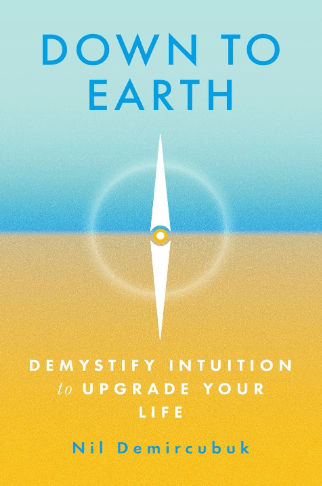
Down to Earth by Nil Demircubuk
Genre: Non-Fiction
Sub-genres: Self-Help, Mindfulness, Psychology and Behavioral Science
Themes: Intuition, Self-awareness, Healing, Empowerment
What if intuition weren’t a mystical gift but a biological function waiting to be understood? Down to Earth by Nil Demircubuk begins with this question and carries it through every page with precision and humility. Drawing from neuroscience, behavioral research, and three decades of personal experience, Demircubuk presents a structured, credible approach to developing intuitive awareness—something she insists we all possess but rarely learn to use well.
The book opens with quiet sincerity: the author’s personal story of loss and recovery, of rebuilding her life after health challenges that forced her to pause and listen differently. From there, she builds a bridge between the rational and the intuitive—between what science measures and what we feel in the instant before thought catches up. Studies like the Iowa Gambling Task and Joel Pearson’s SMILE model appear not as footnotes but as guideposts showing how intuition might live in the body, milliseconds ahead of logic. Demircubuk translates complex findings into something usable: journaling prompts, grounding meditations, and priming exercises that train the mind to notice subtle cues before dismissing them.
One might expect a book about intuition to drift into sentimentality, but Down to Earth stays steady. The tone is pragmatic. It respects both the reader’s skepticism and curiosity. The author repeatedly reminds us that intuition does not replace analysis or medical judgment—it complements them. When she writes, “Listen, but verify,” she models the balance that modern readers crave: emotional intelligence rooted in evidence.
The writing flows with clarity and confidence. Each chapter feels like a workshop where research meets reflection. Exercises such as “Journal Your Intuition” and the “Golden Leaves” meditation demonstrate her ability to translate abstract science into everyday practice. There is even humor tucked into her examples of how intuition can mislead us—small reminders that this faculty, like muscle, requires training and context.
Readers who thrive on empirical rigor and hands-on self-improvement will find this book invigorating. Coaches, educators, psychologists, and anyone navigating major life choices will recognize its immediate relevance. Those who expect sweeping mystical revelations or untested metaphysics, however, may find it too restrained; this is not a book of prophecies or omens but of grounded exploration.
Among the book’s most striking strengths is its authorial credibility. Demircubuk’s career spans engineering, economics, data science, and humanitarian work—fields that demand logic, precision, and empathy in equal measure. That breadth informs her method: she explains intuition as both natural and measurable, something cultivated by attention rather than by chance. Her voice carries the calm assurance of someone who has lived her subject rather than theorized it.
The heart of Down to Earth beats in its invitation to notice. It asks readers to pause between reaction and decision, to find the still, data-rich silence in which intuition speaks. It reframes intuition not as supernatural insight but as the pattern-recognizing wisdom of experience, memory, and emotion—an internal algorithm refined through life itself.
For anyone exhausted by information overload or disconnection from self, this book offers more than reflection—it offers a method. By the time you finish, you may not become “more intuitive” in any mystical sense; instead, you’ll likely feel more present, responsive, and aware of the small signals that shape every choice. In a world that worships speed, Nil Demircubuk gives permission to slow down and listen, proving that sometimes the quietest knowing is also the most reliable.
Content Warning: Contains brief descriptions of accidents and personal health challenges, presented sensitively and without distressing detail.
Global Spines Book Award

This book is a winner of the Global Spines Book Award, which honors exceptional works of literature that transcend borders and speak to universal human experiences. This award celebrates stories that connect readers across the globe, offering fresh perspectives and exploring the richness of cultural diversity. Each winning book reflects the spirit of Global Spines—stories that bridge gaps, foster understanding, and resonate with readers from all walks of life. By recognizing these powerful narratives, we aim to inspire deeper connections and celebrate the power of global storytelling.
We’d love to hear from you!
What are your thoughts on this piece? Share your insights in the comments below!
- What stood out to you most about this post?
- Have you read a book recently that relates to the themes discussed here?
- What’s your favorite takeaway or reflection from this write-up?
Let’s keep the conversation going—your thoughts make this space richer!
Disclaimer: The content on this site is provided for informational and inspirational purposes only. While we strive for accuracy, the views expressed in reviews, articles, and recommendations are subjective and may not reflect the opinions of all readers.
We receive complimentary copies of all books we review. However, this practice does not compromise the integrity or honesty of our reviews. Every write-up reflects the contributor’s genuine impressions and critical analysis, ensuring transparency and trust with our readers.
For a complete understanding of our practices, please refer to our full Disclaimer, Privacy Policy, and Terms of Service. These documents outline how we manage your information, ensure transparency, and uphold your rights as a user.
To request for a review, to nominate your favorite book for an award, or for more details about our awards, click here.
Other Stories

Holy Parrot by Angel A
Holy Parrot tosses together what seems like the setup for a comic sketch, then deftly morphs it into a deeply human, tender, and investigative journey.

Carmella Parker on Law, Education, and Guiding Institutions Through Change
How do you teach students about laws that are still being written? This interview explores one legal educator’s answer—revealed through experience, strategy, and real-world change inside the evolving legal landscape.
The Stress Book by Dr. D. Terrence Foster
What do dental floss, your Wi-Fi signal, and your unresolved childhood goals have in common? Surprisingly, a lot. Read on to see how they all tie into your everyday stress—and how this book untangles it.

 OneTribune