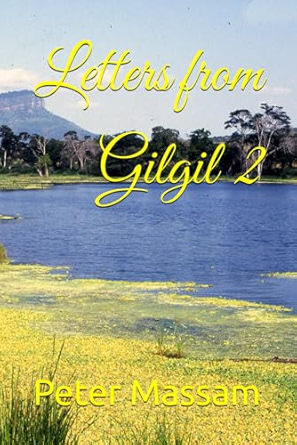
Peter Massam’s second volume in the Letters from Gilgil series is both a continuation and an elevation. If the first book was an overture—a gentle introduction to life in Kenya—this one is the full symphony, rich with movement, contrast, and occasional tension. Rather than repeat or embellish the style of the first, Letters from Gilgil 2 introduces deeper emotional and environmental layers, as the author ventures further from home, into even more remote, majestic, and sometimes sobering parts of East Africa.
This volume, reconstructed from letters sent home during a teaching placement in the 1980s, pulses with insight about ecosystems, memory, and resilience. And surprisingly, it’s often the landscape itself—not the animals, not the humans—that seems to be narrating. From the glistening Tana River to the cracked salt pans of Amboseli, Massam listens carefully to what the terrain is saying.
The Dust Is Not Dead: How Land Speaks
Ever watched a patch of grass “breathe” in early morning dew? Or seen a jeep kick up clouds of ash that used to be a forest? The land Massam describes is not static—it changes, sometimes in minutes. He gives the reader vivid accounts of places like Meru and Tsavo, where herds of 250 elephants appear like tidal waves, and others like Shetani, where lava once flowed so violently the name still evokes dread (“Shetani” means “devil”).
Through it all, he carefully connects observation to deeper meaning. For example, the description of rain failing to arrive in Amboseli becomes more than a meteorological note—it’s a meditation on how hope itself can become parched. A mirage seen near Kilimanjaro turns into a metaphor for perception, distance, and mistaken certainty.
People in the Margins, Yet Never Forgotten
Though wildlife is central to the narrative, the people—often in the background—leave a strong impression. A school matron who uses gentian violet to treat bruises, a craftsman who teaches you to use “God’s cutlery” instead of forks, and a sailor who burns barnacles off his boat’s hull with open fire: these characters aren’t side notes. They are tributes to improvisation, dignity, and local knowledge.
Cultural detail is woven in, not plastered on. There’s a mention of Islamic architectural influence on the coast, the nuanced behaviors of wildlife observed without sensationalism, and respectful mentions of indigenous tribes like the Turkana and Samburu. Not once does the book veer into exoticism or stereotype. It educates by example, not by lecture.
The Photography of Language
Massam’s background in photography shapes the way he frames experience. A lioness seen across a marsh becomes more than an animal—it’s a lesson in camouflage, patience, and potential energy. A brilliantly colored bird stays still long enough for a three-photo sequence—an event so rare that it becomes almost a parable about timing and luck. The visual details are crisp but never cluttered; the writing has a clarity akin to a well-composed slide: focused, vivid, balanced.
Scientific tidbits are dropped with perfect timing. Did you know that the sitatunga antelope has hooves adapted to swampy wetlands, like webbed feet? That hippos move like dancers underwater? That zebras and wildebeests migrate repeatedly across the same river bend for no better reason than instinct?
From Personal Travelogue to Collective Witness
Perhaps most powerfully, this book doesn’t just record travel. It witnesses. Massam documents the disappearance of green, the threat of poaching, the realities of drought, and even the elephant graveyards with a kind of soft-spoken urgency. Yet, he never falls into despair or polemic. There’s too much beauty, too much life left to celebrate.
And that might be the book’s real message: to see, to notice, to remember—especially now, when so much of the world is busy forgetting its living heritage.
Closing Reflections: A Book for Families, Educators, and Dreamers
With no violent content, no offensive language, and an underlying tone of curiosity and compassion, this book is a goldmine for parents and teachers. It encourages ecological awareness, intercultural understanding, and scientific curiosity without ever being didactic. And the writing—its rhythm, its humility, its affection—will win over anyone who’s ever looked out a car window and wondered what stories the land could tell, if we just slowed down and listened.
Rating: ⭐⭐⭐⭐⭐ (5 out of 5 stars)
A remarkable follow-up that deepens the themes of connection, curiosity, and conscience. For all its modesty, Letters from Gilgil 2 deserves a place on any shelf devoted to meaningful, enduring storytelling.
Beyond Boundaries Reads Book Award
This book is a winner of the Beyond Boundaries Reads Book Award. The award honors exceptional works of literature that transcend borders—geographical, cultural, and imaginative. This award celebrates stories that connect us, foster empathy, and highlight universal themes while amplifying diverse voices from around the world. Spanning fiction, nonfiction, poetry, and youth literature, it recognizes books that inspire, challenge, and deepen our understanding of the global human experience.
We’d love to hear from you!
What are your thoughts on this piece? Share your insights in the comments below!
- What stood out to you most about this post?
- Have you read a book recently that relates to the themes discussed here?
- What’s your favorite takeaway or reflection from this write-up?
Let’s keep the conversation going—your thoughts make this space richer!
Disclaimer: The content on this site is provided for informational and inspirational purposes only. While we strive for accuracy, the views expressed in reviews, articles, and recommendations are subjective and may not reflect the opinions of all readers.
We receive complimentary copies of all books we review. However, this practice does not compromise the integrity or honesty of our reviews. Every write-up reflects the contributor’s genuine impressions and critical analysis, ensuring transparency and trust with our readers.
For a complete understanding of our practices, please refer to our full Disclaimer, Privacy Policy, and Terms of Service. These documents outline how we manage your information, ensure transparency, and uphold your rights as a user.
To request for a review, to nominate your favorite book for an award, or for more details about our awards, click here.
Other Stories

Holy Parrot by Angel A
Holy Parrot tosses together what seems like the setup for a comic sketch, then deftly morphs it into a deeply human, tender, and investigative journey.

Carmella Parker on Law, Education, and Guiding Institutions Through Change
How do you teach students about laws that are still being written? This interview explores one legal educator’s answer—revealed through experience, strategy, and real-world change inside the evolving legal landscape.

The Stress Book by Dr. D. Terrence Foster
What do dental floss, your Wi-Fi signal, and your unresolved childhood goals have in common? Surprisingly, a lot. Read on to see how they all tie into your everyday stress—and how this book untangles it.
 OneTribune